integrated metrology community.

News
Bringing trustworthy digital tools for quantitative measurements in Magnetic Resonance Imaging
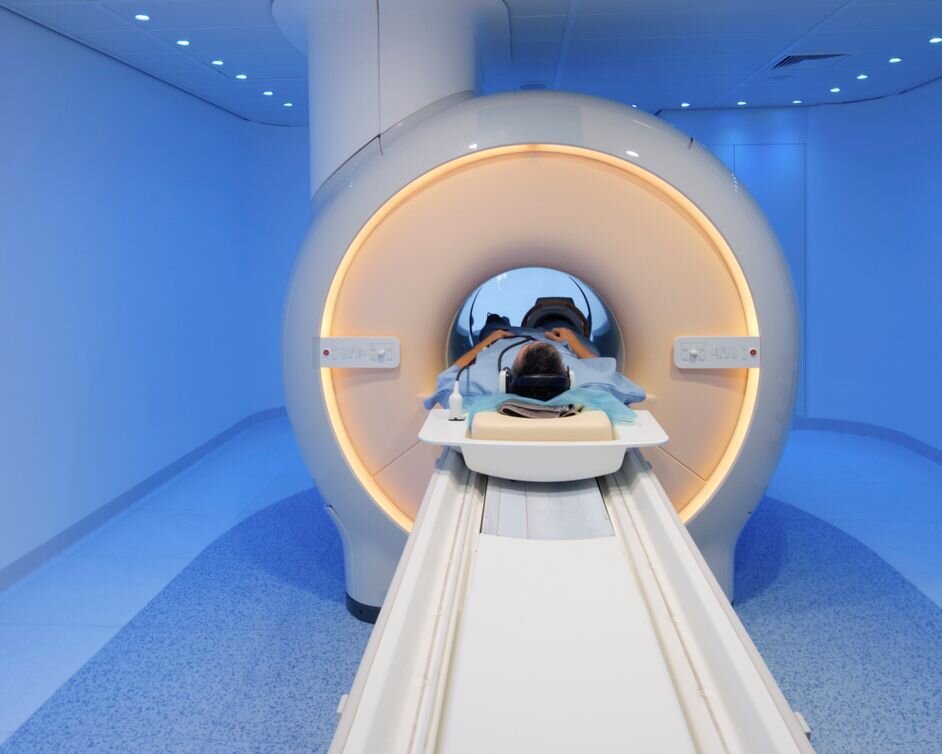
MRI scan
Quantitative MRI aims to act as a non-invasive biopsy, supporting diagnosis, monitoring disease progression, and evaluating therapy effectiveness
The project
European Health policy aims to support the modernisation and digitisation of health systems and infrastructure to protect and improve the health of EU citizens. One area that could benefit from digitisation strategies is Magnetic Resonance Imaging (MRI) where magnetic fields and radio waves are used to produce detailed images of the inside of the body.
Specifically, a branch of MRI called Quantitative magnetic resonance imaging (qMRI) investigates techniques that aim to play the role of non-invasive virtual biopsies. A dedicated metrological framework is therefore needed to produce pixel-wise maps of parameters and their uncertainties, to make qMRI results trustworthy, objectively comparable and machine-interpretable. That is, that they need to be readable by a computer, which will be able to perform a preliminary lesion detection, or to assess changes with respect to previous images of the same patient. This will generate an enormous opportunity for medical imaging, promoting digital health readiness, boosting personalised medicine, and contributing to the development of virtual human twins for medical planning and training.
However, MR images are currently qualitative not quantitative and not directly comparable between different MRI scanners or scans made at different locations. Recently, qMRI techniques have emerged, such as Magnetic Resonance Fingerprinting and Electric Properties Tomography. These can apply measurement uncertainty to individual pixels of an image, allowing direct comparability of measurements across devices, and are suitable for automated methods. The reliability of these approaches still remains an issue, however, due to the complexity of the measurement pipeline.
Focusing on Electric Properties Tomography and Magnetic Resonance Fingerprinting as case studies, Metrology Partnership project Trustworthy and quality-assured quantitative magnetic resonance imaging (24DIT01, APULEIO) is working to produce a dataset of interoperable reference data and quality-assured reconstruction software with embedded uncertainty estimation.
Video
The project consortium has produced a video that provides an overview of the Metrology Partnership project.
Luca Zilberti from INRiM said
‘Without uncertainty, any measurement is almost meaningless. In APULEIO, our goal is to establish a framework for evaluating pixel-wise uncertainty in qMRI. This will allow us to meaningfully compare the measurements acquired on a patient with the relevant physiological ranges, as well as the measurements taken at various time points, thereby determining whether the observed differences are genuinely significant or not.’
This Metrology Partnership project has received funding from the European Partnership on Metrology, co-financed by the European Union Horizon Europe Research and Innovation Programme and from the Participating States.
Want to hear more about EURAMET?
Sign up for EURAMET newsletters and other information
Follow us on LinkedIn and X/Twitter
Information
- European Partnership on Metrology,
- Metrology for Digital Transformation,
- EMN Mathematics and Statistics,

Developing a metrologically-based field assessment of glare and obtrusive light more

Standardising industrial procedures for the magnetic properties of devices leading to the improved quality of a wide variety of products more
Implementing quantum-based pressure measurement techniques in European industries more

Developing reference materials for mass spectroscopy to monitor radioactive and stable isotope pollution in the environment more

Development of the metrological network needed to realise and implement 6G technology more