integrated metrology community.

News
EMPIR project conducts calibration intercomparison for mercury concentrations in the atmosphere
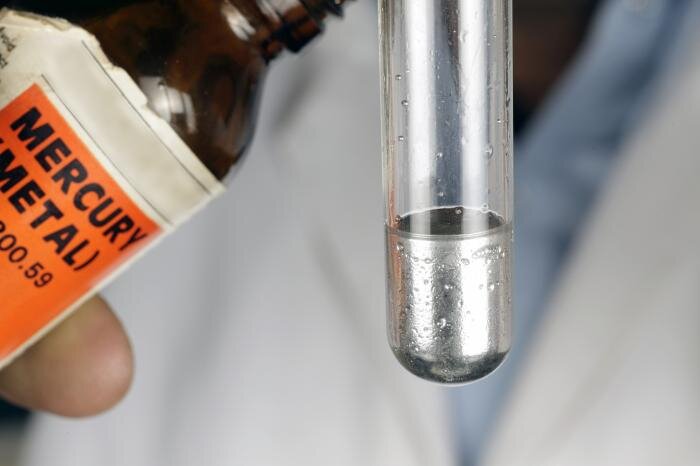
Mercury metal being poured into a test tube
Accurate measurement of mercury concentrations in the atmosphere is vital to protecting people and the environment from the most toxic heavy metal
The project
Mercury (Hg) is a toxic metal released during some industrial processes and poses one of the greatest hazards to human, animal and environmental health. Mercury emissions are regulated by legislation such as the Industrial Emissions Directive 2010/75/EU, the Waste Incineration Directive 2000/76/EC and, in particular, the Minamata Convention, which requires signatories to monitor levels of mercury throughout its lifecycle in the environment.
However, a lack of SI traceable measurements and validated methodologies has hampered the ability to meet their requirements. Primary standards and SI traceable calibration methods for mercury concentrations in air have also been lacking, which has meant mercury gas generators used to calibrate field measurements have not had metrological traceability. This has led to inaccurate measurements and making intercomparisons between measurement at both the European and global levels impossible.
EMPIR project ‘Metrology for traceable protocols for elemental and oxidised mercury concentrations’ (19NRM03, SI-Hg) has new protocols for the calibration of both elemental (Hg0) and oxidised (HgII) mercury generators. These protocols have been validated for generators used in the field and ensure measurements are repeatable, reproducible and comparable between different times and locations.
Intercomparison
The project organised an intercomparison campaign for mercury concentration measurements at an air monitoring station located in Rende, Italy.
The campaign, organised by project partner CNR-IIA (National Research Council, Institute of Atmospheric Pollution Research), Italy, aimed to evaluate the performance of different devices used to calibrate common instruments for atmospheric mercury analysis, with a focus on automated instruments. Different calibration techniques were tested under real field conditions over the course of the several week-long campaign. Commercial passive samplers were also installed and compared with the automated instruments.
A report on the results of the intercomparison is available on Zenodo, alongside photos from the comparison on the project website: here and here.
Presentations
To disseminate its results, the project has given a number of high-profile presentations.
A special session was held during the International Conference on Mercury as a Global Pollutant (ICMGP) titled “Metrology traceability for mercury analysis and speciation.” This session was a collaboration between the SI-Hg project and the GMOS-train project and included a presentation from project coordinator Iris de Krom detailing the protocol for measuring elemental mercury in air developed by the project. Iris de Krom was also interviewed as part of the conference, a video of which is available to watch online.
The project also gave a presentation titled “Comparability of the measurement results for gaseous elemental mercury (GEM)” at Minamata Online, an online event supporting government officials, scientists and other stakeholders of the Minamata Convention. Recordings of this presentation and others are available to watch online.
Project coordinator Iris de Krom (VSL) has said of the project:
“The SI-Hg project partners made great steps forward to improve the metrology for mercury concentrations in emissions sources and the atmosphere. Together, they developed and validated protocols for the metrological sound calibration of mercury gas generators used in the field. Currently the protocols are converted into documentary standards in CEN/TC 264 WG 8. Once the documentary standards are available they will replace other references used in industry to calibrate mercury gas generators and ensure SI traceable measurement results for mercury concentrations in emission sources and the atmosphere. This is essential to underpin global efforts to control and reduce mercury concentrations, comply with legislation and protect human health.”
This EMPIR project is co-funded by the European Union's Horizon 2020 research and innovation programme and the EMPIR Participating States.
Want to hear more about EURAMET?
Information
- EMPIR,
- Standardisation,
- EMN Pollution Monitoring,
- EMN Climate and Ocean Observation,

Developing a metrologically-based field assessment of glare and obtrusive light more
Standardising industrial procedures for the magnetic properties of devices leading to the improved quality of a wide variety of products more
Implementing quantum-based pressure measurement techniques in European industries more

Developing reference materials for mass spectroscopy to monitor radioactive and stable isotope pollution in the environment more

Development of the metrological network needed to realise and implement 6G technology more