integrated metrology community.

News
EMPIR project improves reference gas standards for climate relevant volatile organic compounds
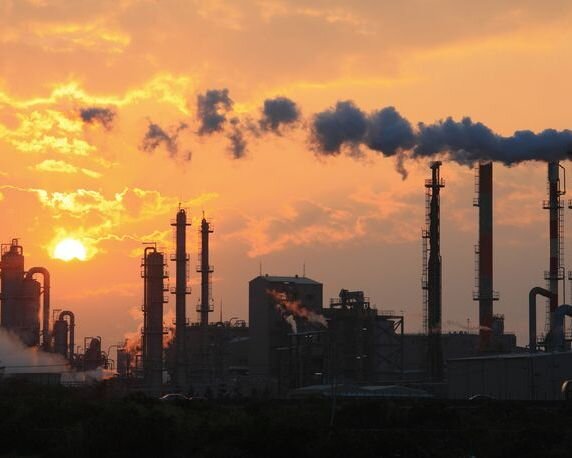
Air pollution from factory pipes
New methodology enables better tracking of atmospheric trends
The project
Volatile organic compounds (VOCs), as ozone and aerosol precursors, play an important role in the oxidative capacity of the lower atmosphere and contribute to radiative forcing. Thus, long-term, accurate and traceable VOC measurements are pivotal to understanding changes in climate and their effects on environment and society.
However, VOC low atmospheric amount-of-substance fractions, their reactiveness and the lack of stable and traceable standards for some VOCs make their sampling, analysis and calibration challenging.
Completed EMPIR project Metrology for climate relevant volatile organic compounds (19ENV06, MetClimVOC) built on the work of EMRP projects KEY‑VOCS and HIGHGAS to address measurement uncertainty for selected VOCs. Understanding atmospheric levels of these is important to help effectively monitor climate change.
New accurate, primary reference gas mixtures were developed for oxy-VOCs, terpenes and halogenated VOCs with validated protocols to allow the generation of working gas standards.
Project outputs
Specific achievements from the project include:
- Developing, for the first time, traceable, stable reference gas mixtures of priority oxygenated and halogenated VOCs at low amount-of-substance fractions and uncertainties (≤ 100 nmol/mol, ≤ 5 % expanded uncertainty and at least 18 months temporal stability). This work is described in the paper Towards a high-quality in situ observation network for oxygenated volatile organic compounds (OVOCs) in Europe: transferring metrological traceability to the field.
- Publishing training videos on how to establish SI traceability and how to produce reference gas mixtures of climate relevant VOCs https://www.metclimvoc.eu/training.html
- Providing significant input into a new normative document for the Global Atmosphere Watch (WMO-GAW): 281. Guidelines for Measurements of Non-Methane Hydrocarbons in the Troposphere
- Providing a priority list of VOCs to the revision of the Ambient Air Quality Directive which came into force in December 2024
- Providing Input to EMN for Climate and Ocean Observation Strategic Research Agenda
- One member of the consortium was designated as the Central Calibration Laboratory for ten halogenated VOCs within the WMO-Global Atmosphere Watch Programme.
- Selection for the technical committee (EURAMET TC-IM 1449) as a case study and example to follow by coordinators to elaborate and follow data management plans
- Contributing spectra on carbon tetrachloride and sulphur hexafluoride to the HITRAN database
- Providing results taken up by air monitoring networks (AGAGE, ACTRIS, WMO-GAW) to allow traceability for VOC measurements
- Developing a user-friendly on-line tool, TUCAVOC, to calculate uncertainties, guidelines and training on metrological aspects to monitoring stations
Work from this project is continuing in a Swiss funded project SI-haloVOCs.
The outputs of this project resulted in more accurate and harmonised data that will improve the identification of climate and air quality trends. This will lead to the adoption of more effective mitigation strategies, which will generate long-term economic impact by decreasing the costs related to air pollution and climate change. Effective mitigation policies will create environmental impact by limiting the use and emissions of VOCs through more strict legislation and treaties.
The future harmonised datasets will additionally lead to a better understanding of long-term global VOC emissions and of the chemistry involved by the scientific community.
Project coordinator Celine Pascal from METAS said
‘The strength of the project was the perfect complementarity skills of the consortium containing national metrology institutes, industry partners and direct end-users. These enabled fit-for-purpose reference materials and methods according to the needs of the stakeholders’.
This EMPIR project is co-funded by the European Union's Horizon 2020 research and innovation programme and the EMPIR Participating States.
Want to hear more about EURAMET?
Information
- EMPIR,
- Environment,
- EMN Climate and Ocean Observation,
- TC-MC,

Developing a metrologically-based field assessment of glare and obtrusive light more
Standardising industrial procedures for the magnetic properties of devices leading to the improved quality of a wide variety of products more
Implementing quantum-based pressure measurement techniques in European industries more

Developing reference materials for mass spectroscopy to monitor radioactive and stable isotope pollution in the environment more

Development of the metrological network needed to realise and implement 6G technology more