integrated metrology community.

News
Optical atomic clock used to measure gravitation for the first time
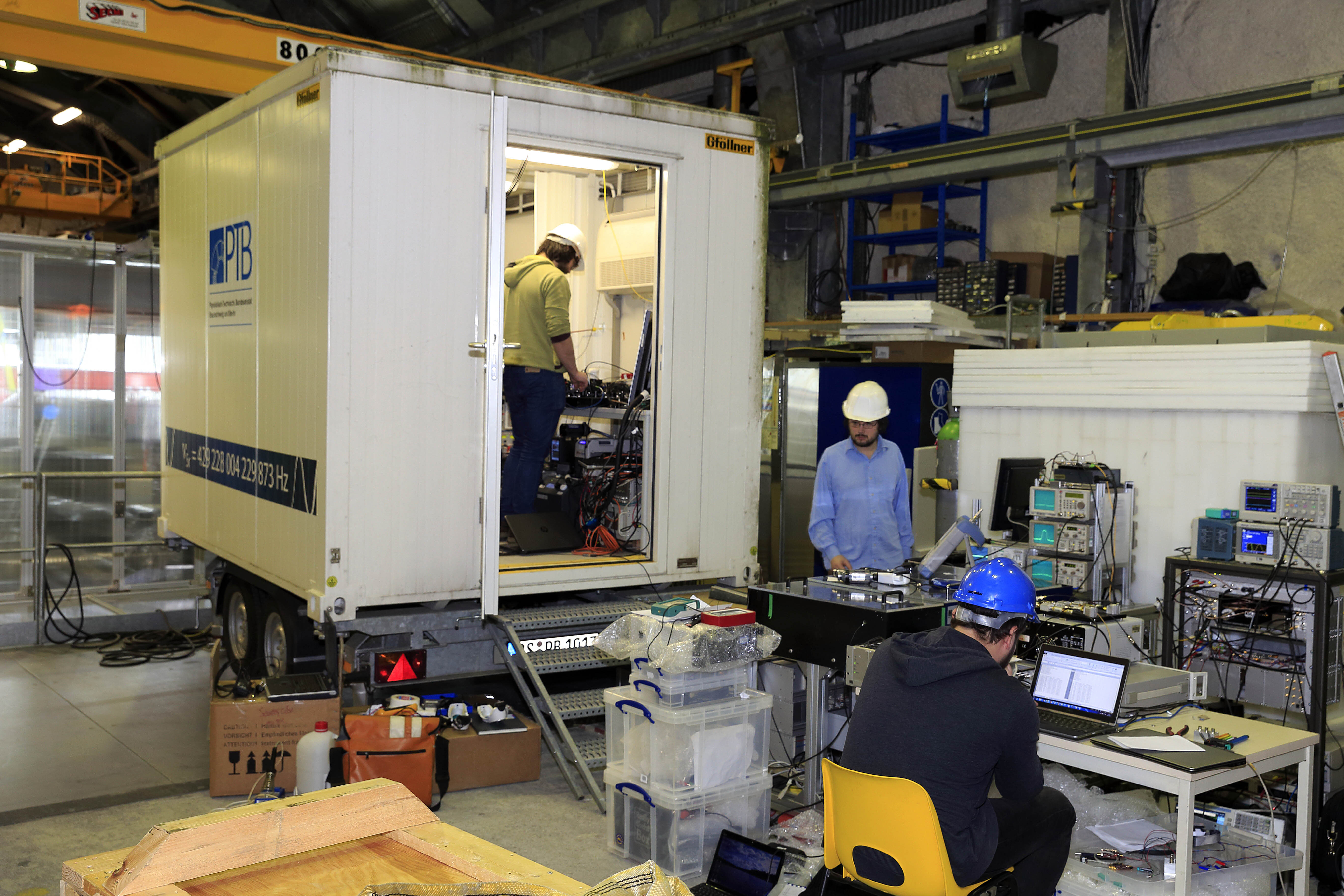
The PTB transportable optical lattice clock, inside its trailer at LSM
EMRP project makes measurement using new transportable clock
EMRP collaborative project '<link research-innovation search-research-projects details>International timescales with optical clocks' (SIB55, ITOC) made significant advances in addressing some of the measurement challenges associated with the possible forthcoming change to redefine the second in terms of an optical transition frequency.
In addition, the project partners used one of the world's only transportable optical atomic clocks to measure gravitation for the first time. This was achieved by measuring the gravitational redshift of the clock operating frequency, which is possible due to the very high levels of stability and accuracy demonstrated by optical clocks.
Until now, such delicate clocks have been restricted to laboratories at a few major research institutions; however, researchers at PTB, Germany, developed a new transportable strontium optical lattice clock, opening up the possibility of performing measurements in the field.
The team measured the gravity potential difference between the exact location of the clock at the Laboratoire Souterrain de Modane (LSM) in the Fréjus road tunnel between France and Italy and a second clock at INRIM – located 90 kilometres away in Torino, Italy, at a height difference of about 1000 metres.
With improvements to the accuracy of the transportable optical clock, this technique has the potential to resolve height differences as small as 1 centimetre across the Earth's surface. The advantage of using optical clocks is that they can make measurements at specific points, in contrast to satellite-based measurements which average the gravity potential over length scales of about 100 kilometres.
This novel method could lead to higher resolution measurements of the Earth's gravity potential, allowing scientists to monitor – with unprecedented accuracy – continental height changes related to sea levels and the dynamics of ocean currents. It will also lead to more consistent national height systems.
Helen Margolis, Fellow in Optical Frequency Standards and Metrology at NPL, UK, said
"Our proof-of-principle experiment demonstrates that optical clocks could provide a way to eliminate discrepancies and harmonise measurements made across national borders. One day such technology could help to monitor sea level changes resulting from climate change."
The results of the experiment were published in the following articles:
This EMRP joint research project is part of EURAMET’s European Metrology Research Programme. The EMRP is jointly funded by the EMRP participating countries within EURAMET and the European Union.
Information
- EMPIR,
- Industry,
- SI Broader Scope / Integrated European Metrology,
- SI redefinition,

Developing a metrologically-based field assessment of glare and obtrusive light more

Standardising industrial procedures for the magnetic properties of devices leading to the improved quality of a wide variety of products more
Implementing quantum-based pressure measurement techniques in European industries more

Developing reference materials for mass spectroscopy to monitor radioactive and stable isotope pollution in the environment more

Development of the metrological network needed to realise and implement 6G technology more