integrated metrology community.

News
Partnership project delivering first reference materials for stable isotope ratios in seawater
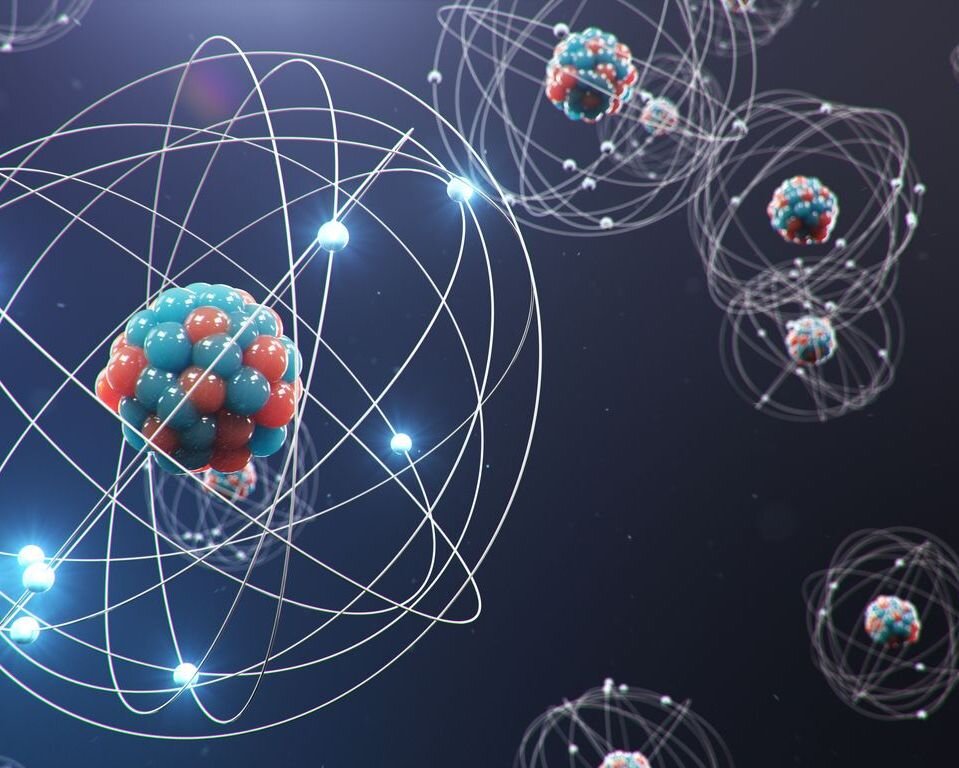
3D Illustration of Atomic structure
Developing certified reference materials for mass spectroscopy to monitor radioactive pollution in the environment
The European Green Deal’s goal of a “toxic-free environment” and “reducing air, water and soil pollution” requires highly sensitive state-of-the-art detection techniques for monitoring both radioactive and stable environmental pollutants. The isotopic compositions of elements vary in the environment due to natural processes, but for certain elements, processes such as radioactive decay, the interaction of cosmic rays with the atmosphere, industrial activities, and nuclear weapon testing and accidents. In either case, variation in isotopic compositions is a powerful tool for identifying the origins of materials.
Radiometric determination is well-established for detecting short-lived (< 10 years) radionuclides and mass spectrometry, including Inductively Coupled Plasma Mass Spectrometry (ICP-MS), allows the rapid determination of multiple elemental pollutants at a high throughput. Recent advances in ICP-MS have significantly enhanced sensitivity and precision, enabling the reliable detection of even minute variations in the isotopic composition of elements with more than one natural isotope.
However, mass spectrometers require validation using traceable reference materials (RMs) since known mass biases within the technique must be accounted for and quantified. A significant analytical challenge remains due to the vast number of analyte/matrix combinations, matrix effects, spectral interferences, and instrumental isotopic fractionation that must be characterised before and during the measurements. Multi-element RMs are often unavailable and single-element RMs exist only for a limited number of species and matrices.
New liquid and solid radionuclide refence materials
This lack is being addressed by the Partnership project Metrology for the harmonisation of measurements of environmental pollutants in Europe (21GRD09, MetroPOEM), which is producing both liquid and solid radioactive certified reference materials for the calibration of mass spectrometers.
For the development of the liquid materials 250 litres of water was collected in May 2023 from the North Sea. This was performed as part of the regular monitoring research cruise of the RV ATAIR operated by the German Bundesamt für Seeschifffahrt und Hydrographie (BSH). After treatment to stabilise the water, it was processed by project partners Helmholtz-Zentrum Hereon and TÜBİTAK UME, the National Metrology Institute (NMI) of Turkey for stable isotopes and CMI, the NMI of Czechia where it is used to generate the first liquid refence materials containing actinide nuclides (234U, 235U, 236U, 238U, 237Np, 239Pu, 240Pu and 241Am).
In addition, MetroPOEM is producing a solid radioactive reference material. This is done by synthesising a silicate matrix from liquid precursors including radioactive ones. This gives the new material two main advantages – the first is it allows radioactivity to be bound within the silicate matrix and not only at the surface of the material – and the second is that synthesising the material enables control over its composition and thus better traceability of the material.
LNE-LNHB, one of the Designated Institutes (DIs) of France, has produced the first 20 batches of inactive solid reference material and the next step is to spike the material with 241Am to estimate its homogeneity by γ-spectrometry directly or after dissolution.
Details of the collection and production of these new refence materials can be found in the project’s second newsletter.
New BIPM task group
In recognition of the importance of the role of mass spectroscopy the Bureau international des poids et mesures (BIPM) established a new Task Group on Mass Spectrometry (CCRI(II)-MS-TG). Supported by Consultative Committee for (i) Amount of Substance: Metrology in Chemistry and Biology (CCQM) and (ii) Ionising radiation (CCRI), it includes three scientists from the MetroPOEM consortium.
The project’s aim of bridging the gap between radiometric techniques and mass spectrometry will accelerate the uptake of the latter technique for detecting environmental contaminants, helping to reduce the detection limits and improving response times for pollution incidents. This will reduce human and environmental exposure to radiation and toxins and provide support for the goals of the Green Deal.
Dirk Arnold (PTB) said about the project:
“The project will go beyond the state of the art with the development of two radioactive reference materials (RM), respectively liquid and solid, containing the radioactive pollutants U, Np, Pu, Am for use in an inter-laboratory comparison employing techniques used for the measurement of the activity standards solutions, which will demonstrate the variations in parameters including detection limits, sample preparation requirements, sample introduction.”
This Metrology Partnership project has received funding from the European Partnership on Metrology, co-financed by the European Union Horizon Europe Research and Innovation Programme and from the Participating States.
Want to hear more about EURAMET?
Sign up for EURAMET newsletters and other information
Follow us on LinkedIn and X/Twitter
Information
- EMN Pollution Monitoring,
- EMN Climate and Ocean Observation,
- EMN Radiation Protection,
- TC-IR,
- TC-MC,
- Green Deal,

Developing a metrologically-based field assessment of glare and obtrusive light more

Standardising industrial procedures for the magnetic properties of devices leading to the improved quality of a wide variety of products more
Implementing quantum-based pressure measurement techniques in European industries more

Developing reference materials for mass spectroscopy to monitor radioactive and stable isotope pollution in the environment more

Development of the metrological network needed to realise and implement 6G technology more