integrated metrology community.

News
Partnership project develops metrology basis for soil moisture measurements on multiple scales
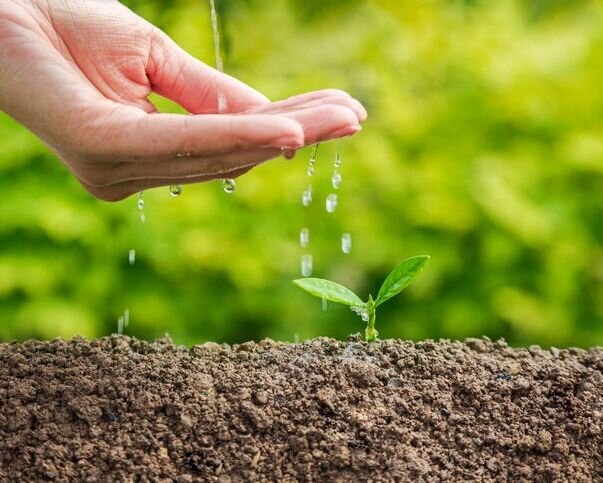
Hand watering a small tree
Soil moisture affects agriculture, weather and climate trends. To understand relationships measurements over multiple scales and times are needed
Water and soil are vital resources seriously affected by climate change and environmental degradation. Fresh water at the land surface, primarily in the form of soil moisture, is a key resource that affects agriculture, forestry, groundwater recharge, weather and climate forecasting, and greenhouse gas emissions. Knowledge of soil moisture is also essential for optimal irrigation management in agriculture. Reliable measurement of soil moisture and its applications in precision agriculture and smart farming will be of growing importance in the face of progressing climate change and a growing world population.
The World Meteorological Organization (WMO) recognizes soil moisture as one of the Essential Climate Variables. It is an important part of the hydrological cycle, influencing water balance and rainfall-runoff processes, and improved monitoring is needed for better prediction of floods, droughts, landslides and wildfires.
Currently, most soil moisture sensors are ‘point sensors’ that monitor small areas (less than 1 m in radius). Measuring greater areas requires large numbers or networks of these sensors, which are both costly and labour intensive to install and maintain. Point measurements are also not representative of the large landscape and there are no SI-traceable standards for the determination of soil water content under laboratory conditions. Combined with the lack of laboratory metrology there is also a number of open questions regarding sensor calibration, installation, maintenance and data interpretation.
Remote sensing of Earth from satellites, on the other hand, can cover much larger areas and is used to assess soil moisture on a kilometre scale for weather and climate research. Earth observation scientists rely on the ground-based soil moisture data to calibrate and validate satellite-based soil moisture product maps. However, many information gaps remain across spatio-temporal scales. In addition, satellite imagery lacks the resolution required for accurate field-scale (of the order of 100 m) soil moisture monitoring and can only access the top 5 cm to 20 cm of the topsoil.
Cosmic-ray neutron sensing (CRNS) instruments
In the last two decades cosmic-ray neutron sensing (CRNS) instruments have emerged. These non-invasive, near-ground detectors have the advantage of estimating integral soil moisture over an intermediate scale (radius of about 100 m and depth of about 0.5 m) and at sub-daily resolutions, providing a new perspective for (agro)meteorological and hydrological observations.
The CRNS method is based upon the fact that when cosmic rays—high-energy radiation from space—interact with the Earth’s atmosphere they produce high-energy neutrons. When these neutrons encounter hydrogen atoms—such as those in water (H2O) in the soil—they are reflected back with lower energy. Continuous measurement of these lower-energy backscattered neutrons can provide a convenient tool for monitoring the water content of the soil around the CRNS instrument. However, whilst the use of cosmic-ray neutron sensing has increased in monitoring stations around the world, the method still lacks metrological traceability to the International System of Units (the SI) and the quantification of uncertainty budgets is the subject of research efforts by the CRNS community.
The European Partnership on Metrology project Metrology for multi-scale monitoring of soil moisture (21GRD08, SoMMet) addresses the above issues. In an interdisciplinary approach, two SI-traceability chains of i) soil water content determination and ii) neutron measurements with CRNS instruments are being developed under laboratory conditions, with the aim of transferring them to field and combining them under outdoor conditions. Soil moisture measurements are being carried out at three environmental research sites in Germany and Italy using point-scale sensors, CRNS systems and satellite-based data products. The data from the measurement campaigns will be used for metrological harmonisation and data fusion of soil moisture observations across multiple scales.
The results of the project will support manufacturers and end users of point scale and CRNS sensors and, in the long term, the overall comparability and interoperability of different soil moisture assessments.
The coordinator of the project Miroslav Zboril (PTB) said about the work:
“With this project, we aim to bring the different methods of measuring soil moisture onto the common basis of international SI standards, making them more comparable and reliable. This will help scientists and decision-makers in agriculture, hydrology and related fields such as weather forecasting and climate change mitigation. With the CRNS method, the scientific community aims to bridge the gap between the two established methods of soil moisture observation, and within this project we are developing the necessary metrological framework. Our project consortium is truly multidisciplinary and includes experts on metrology of temperature and humidity, as well as experts on metrology of neutron radiation. We are also working closely with the European Space Agency (ESA)-funded FRM4SM (Fiducial Reference Measurements for Soil Moisture) project, which is looking at soil moisture observations from a satellite community perspective.”
This Metrology Partnership project has received funding from the European Partnership on Metrology, co-financed by the European Union Horizon Europe Research and Innovation Programme and from the Participating States.
Want to hear more about EURAMET?
Information
- European Partnership on Metrology,
- EMN Safe and Sustainable Food,
- EMN Climate and Ocean Observation,
- Green Deal,

Developing a metrologically-based field assessment of glare and obtrusive light more

Standardising industrial procedures for the magnetic properties of devices leading to the improved quality of a wide variety of products more
Implementing quantum-based pressure measurement techniques in European industries more

Developing reference materials for mass spectroscopy to monitor radioactive and stable isotope pollution in the environment more

Development of the metrological network needed to realise and implement 6G technology more