integrated metrology community.

News
Supporting the circular economy by enabling the retrieval of trace elements from electrical waste
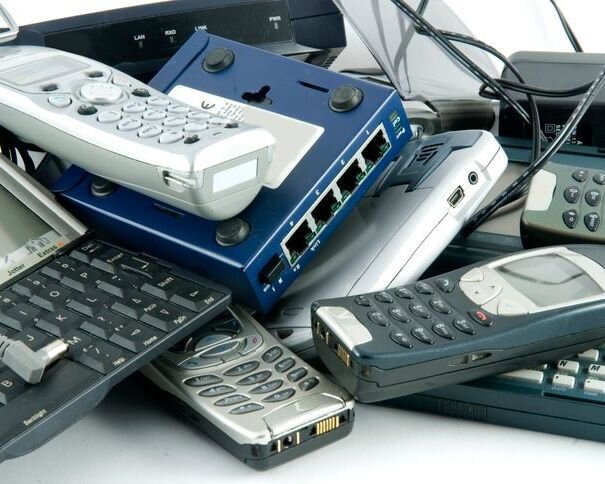
Obsolete electrical equipment
Validated, SI-traceable reference methods and materials to assess trace elements in discarded goods
In 2019 the value of materials present in urban waste in Europe, in discarded electrical and electronic equipment, approached 11 billion Euro. This waste contains ‘technology critical elements’ (TCE) such as rhodium and platinum used in many high technology applications, including energy-efficient devices. Available amounts of TCE are limited, or located outside of Europe, and the European Commission has identified TCE recycling as a priority of the circular economy agenda.
The amended Waste Framework Directive (2018/851/EU) also contains updated targets for element recycling. However only a few laboratories in Europe have the ability to accurately measure TCE waste content and this, along with a lack of certified reference materials, limits both the quality of recycling and the ability of analysis laboratories to comply with quality control requirements, such as ISO/IEC 17025.
In 2023 the new EU batteries directive came into force (Batteries - European Commission) with the aim of minimising the environmental impact of battery waste, which, from August 2025 fully replaced the previous Directive 2006/66/EC. This is a key achievement under the European Green Deal and aims to hasten the circular economy and zero pollution ambitions of the EU.
Completed EMPIR project Metrology for the recycling of Technology Critical Elements to support Europe's circular economy agenda (20IND01, MetroCycleEU) provided the material and methods to accurately measure Technologically Critical Elements from electronic waste to increase recycling rates.
Project achievements include:
- Developed new reference material based on printed circuit boards, LEDs and Lithium batteries to help calculate recycling efficiency.
- Provided the first interlaboratory comparison on the analysis of Technology Critical Elements (TCE) from urban waste Final report of the InterLaboratory Comparison (ILC): Printed Circuit Boards & Li-Ion Batteries).
- Provided a calculation tool for measurement uncertainties of external calibration, standard addition and isotope dilution measurements metrocycleeu_d5_toolbox.xlsm and a best practice guide on how to use this D5: Best practice guidance For the analysis and uncertainty calculations for TCE in urban mine waste with routine instrumentation used in the recycling industry.
The toolbox has drawn the interest of more than 100 stakeholders and been downloaded over 100 times since the end of the project.
- A spreadsheet-based tool to estimate confidence intervals of measured TCE mass fractions metrocycleeu_d2_calculation_tool.xlsx
- The Lithium battery material produced within the project has been used in a recently completed Supplementary comparison for critical elements in Li-ion battery black mass This is the first electric waste material used in this type of comparison and one of the few to fall under the category ‘difficult to dissolve’ material for transition elements of the CCQM IAWG core capability table. Results are expected to be published in 2026.
Project coordinator Johanna Noireaux from LNE said
‘MetroCycleEU paved the way for the metrology of critical and strategic materials to help the industry better understand the materials for recycling they are dealing with. Now, our job will be to help the industry increase dramatically the use of recycled materials’.
This EMPIR project is co-funded by the European Union's Horizon 2020 research and innovation programme and the EMPIR Participating States
Want to hear more about EURAMET?
Sign up for EURAMET newsletters and other information
Information
- EMPIR,
- Industry,
- EMN Advanced Manufacturing,
- EMN Pollution Monitoring,

Developing a metrologically-based field assessment of glare and obtrusive light more
Standardising industrial procedures for the magnetic properties of devices leading to the improved quality of a wide variety of products more
Implementing quantum-based pressure measurement techniques in European industries more

Developing reference materials for mass spectroscopy to monitor radioactive and stable isotope pollution in the environment more

Development of the metrological network needed to realise and implement 6G technology more